
What Is Operational Intelligence (And Why Dashboards Don't Deliver It)
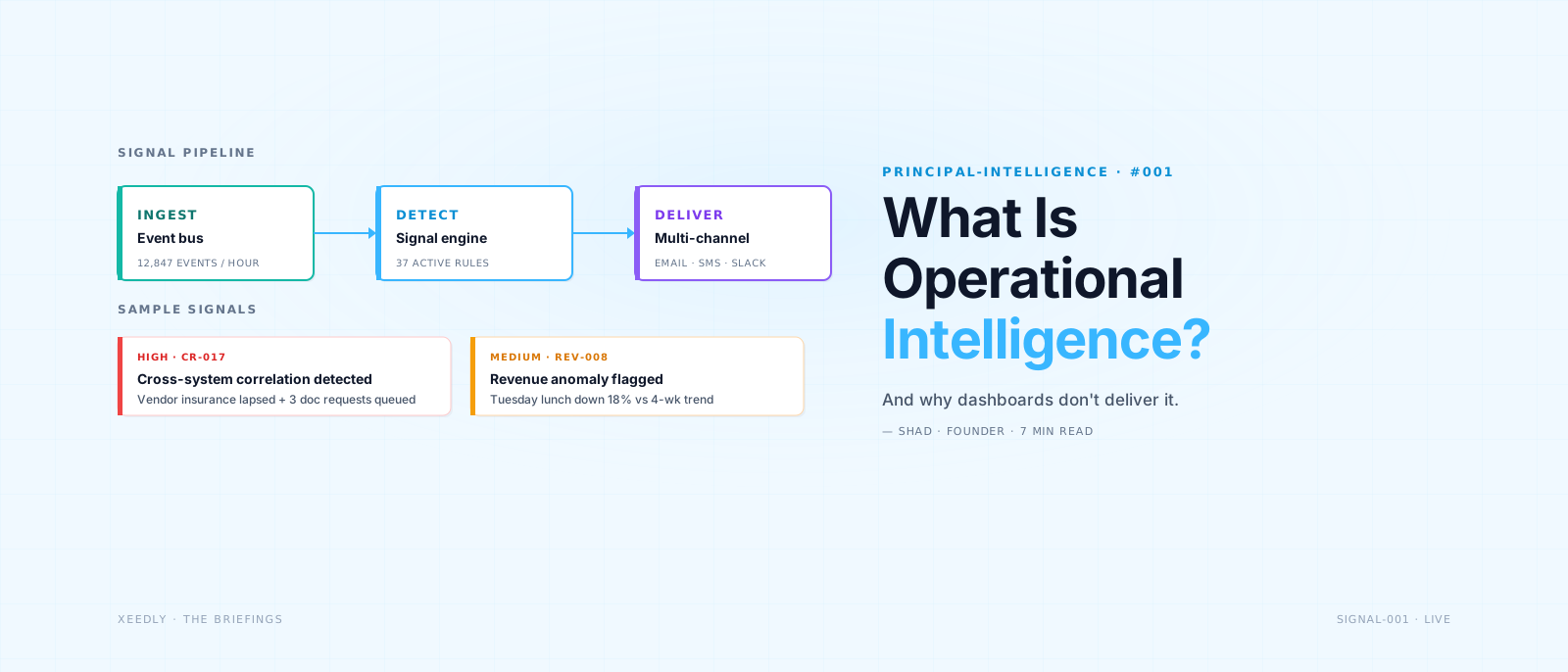
Operational intelligence is the proactive delivery of decision-ready signals across every system your business runs on — surfaced to the right people, in the right channel, at the right time. Dashboards wait for you to come find them. Operational intelligence comes to you.
The Dashboard Trap
Almost every business intelligence tool sold in the last fifteen years promised the same thing: centralize your data, build a dashboard, see everything at a glance. The promise was visibility. The reality was a screen nobody opens.
If you've run a multi-unit or multi-tenant business for any length of time, you know the pattern. You bought the tool. You spent six weeks building the dashboard. The first month, you and your leadership team checked it daily. By month three, it was once a week. By month six, the dashboard was a graveyard of unread metrics and stale data — and the same problems that prompted the purchase were still happening.
That's not a tool problem. That's an architecture problem.
Dashboards are passive. They require you to remember to look, know what to look for, and have the time to look. Real businesses don't work like that. Real leaders don't have those three things lined up reliably.
What Operational Intelligence Actually Means
Operational intelligence is a different category of system. The difference isn't aesthetic — it's structural.
Where a dashboard waits for you to come find it, operational intelligence pushes the signal to you. Where a report runs on a schedule, an intelligence platform reacts to events as they happen. Where business intelligence summarizes the past, operational intelligence surfaces what needs attention right now.
Three architectural choices make this possible:
1. An event bus — not a database query
Every action your business takes is captured as an event: a document is requested, a vendor's insurance expires, a phone call goes unanswered, a unit's revenue dips. Events flow into a single canonical stream. Nothing waits for a nightly ETL job. Nothing relies on a CSV export. The system sees everything as it happens.
2. A signal engine — not just a report builder
Configurable rules and AI correlation scan the event stream for patterns that matter. A vendor compliance gap coinciding with pending work orders. A revenue dip during a high-volume window. A spike in missed calls. The signal engine doesn't show you all your data — it shows you the data that needs a decision.
3. Multi-channel delivery — not behind another login
Signals are pushed to the channels you already use. Email. SMS. Slack. Teams. In-app. The morning briefing arrives in your inbox before your first meeting — categorized, prioritized, actionable. The critical alert pings your phone while you're between properties. Intelligence meets you where you are. Not behind a browser tab.
The Three Depths of Intelligence
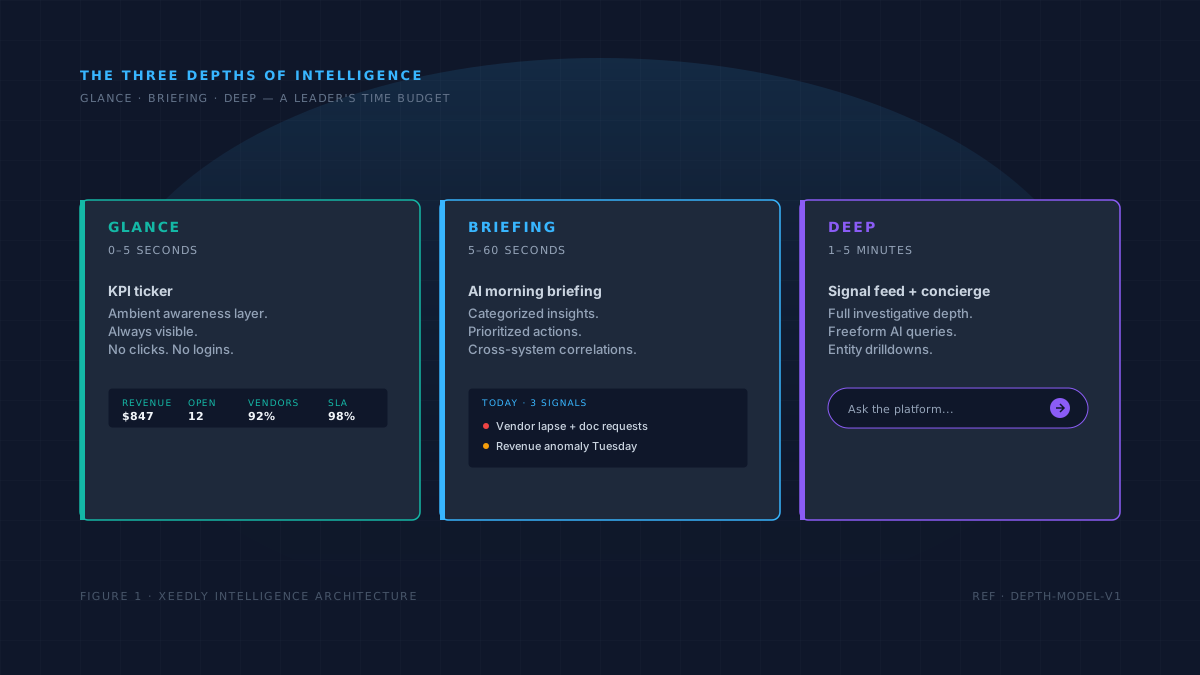
A well-designed intelligence layer delivers at three depths, because different decisions need different time budgets:
| Depth | Time Budget | Use Case |
|---|---|---|
| GLANCE | 0–5 seconds | Always-visible KPI ticker. Ambient awareness. No clicks, no logins, no dashboards. |
| BRIEFING | 5–60 seconds | AI-generated morning briefing. Categorized insights, priority actions, cross-system correlations. |
| DEEP | 1–5 minutes | Full signal feed and AI concierge for freeform queries. Investigative depth when you need to dig. |
If your intelligence layer only operates at one depth, it'll fail. Dashboards are stuck at DEEP — too time-expensive for daily ambient use. Email alerts are stuck at GLANCE — too shallow for actual investigation. A real intelligence layer covers all three and lets you move fluidly between them.
Why This Matters for Multi-Unit Leaders
If you're running a portfolio business — multi-unit restaurants, multi-tenant property management, multi-site service operations, multi-property real estate — you are the constraint in your own organization. Not because you're underperforming. Because the architecture of how information reaches you was designed for a single-location business that doesn't exist anymore.
Operational intelligence is the architecture that fits the business you actually run. It's not a dashboard. It's not a chatbot. It's the system that turns thousands of daily operational events into a small number of decisions a leader actually needs to make — and routes everything else to the people closest to it.
When an intelligence layer is doing its job, you stop being the bottleneck. You start leading the company instead of just operating it. That's not a software outcome. That's a life outcome.
What This Is Not
Three quick clarifications, because the category is crowded with imposters:
- It's not a dashboard. Dashboards are a single-depth, pull-based pattern. Intelligence layers are three-depth, push-based architectures.
- It's not a chatbot. Chatbots wait for you to ask. Intelligence platforms reach out when something needs you.
- It's not generic BI with AI sprinkled on top. Adding a natural-language query to a stale data warehouse doesn't make it intelligent. The architecture has to be event-driven and signal-first from the ground up.
How Xeedly Builds Intelligence Layers
XeedlyAI has deployed this architecture across five verticals — multi-unit restaurants (Sovvrn), HOA management (PropertyDocz + PropertyJobz), property management (Core HOA), property investment (Pando), and SaaS infrastructure (the Xeedly platform itself). Each deployment follows the same pattern: ingest events from your existing systems, detect signals with configurable rules and AI correlation, deliver intelligence in three depths across the channels you already use. Standup time is 2–4 weeks for the core architecture, plus 1–2 weeks per integration. Same architecture, different verticals — proven in production.
Questions, answered.
- What is operational intelligence?
- Operational intelligence is the proactive delivery of decision-ready signals across your business systems. It captures every operational event as it happens, detects patterns through rule-based and AI-driven correlation, and delivers the resulting signals to the right people through the channels they already use — email, SMS, Slack, in-app — instead of behind another dashboard login.
- How is operational intelligence different from business intelligence?
- Business intelligence is retrospective and pull-based — you go look at a dashboard or run a report. Operational intelligence is real-time and push-based — the system surfaces what needs attention now and reaches out through your existing channels. BI tells you what happened. Operational intelligence tells you what to do.
- Do I need a dashboard if I have operational intelligence?
- Yes, but it should be one depth of three, not the whole product. A well-designed intelligence layer includes a GLANCE-level always-visible KPI ticker, a BRIEFING-level proactive morning summary, and a DEEP-level dashboard and AI concierge for investigation. Most BI tools only deliver the third — which is why most BI tools fail to drive daily decisions.
- How long does it take to deploy an intelligence platform?
- Core architecture (event bus, signal engine, multi-channel delivery) takes 2–4 weeks to stand up. Each system integration adds 1–2 weeks. AI persona training adds 3–5 days. A complete deployment with 3–5 connected systems and a custom signal ruleset typically takes 4–8 weeks total.
- Can operational intelligence work for my industry?
- Yes, if your business generates operational events across multiple systems and has leaders who need to make decisions on what's happening across those systems. We've deployed across restaurants, property management, HOA operations, real estate investing, and vertical SaaS. High-fit candidates include fleet management, franchised retail, multi-site healthcare, construction and trades, and commercial real estate.
See what an intelligence layer looks like for your business
Try the Intelligence Console on the homepage, or book a discovery call. We'll map your data landscape and tell you exactly what an intelligence deployment would look like for your vertical.